
Making mmSkylines Part 1: Concepts & Summaries
Making a mmSkyline takes two steps. In this first step you will learn how to find the concepts from the listening sessions that represent interior cognition. Instead of tagging them, you will pull them out into a list and summarize them. Learn why this novel approach is the power that creates mmSkylines. And when we launch the agentic version of this unique type of analysis, get qualified to be a supervisor here.
Required
before you take this course:
Course Listening Deeply
-or- Listening Deeply Pre-recorded Lessons
-or- Book Time to Listen
see if you are ready

Self-paced course

Closed captions

Last updated June 2026

Join Indi’s Slack community

6 month access
About the course
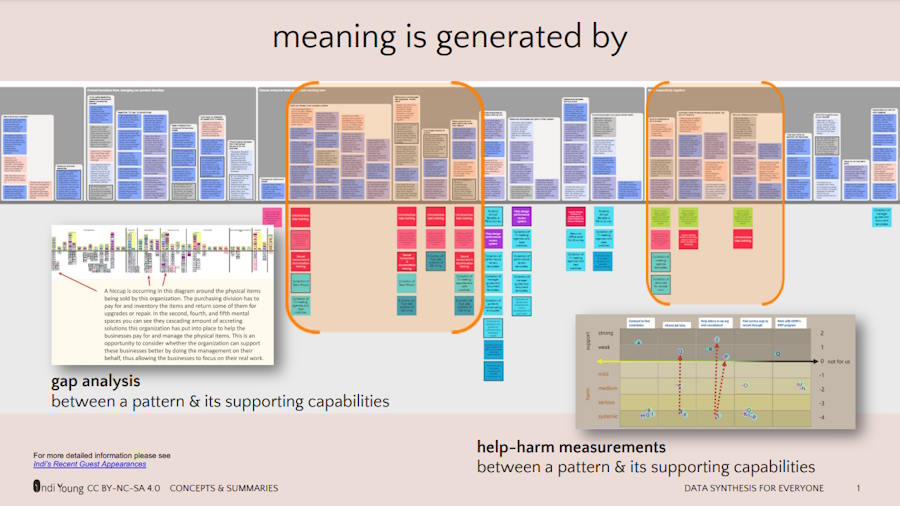
There are two steps to finding the patterns that will become your mental model skyline. The first step is finding the concepts to compare across participants. Currently, transcript analysis within “fast UX” tends to be top-down: you choose what insights you’re interested in, which means your cognitive bias influences your research and conclusions.
This course teaches bottom-up synthesis: a method that helps you avoid cognitive bias and let people’s different perspectives get represented their way. It requires keeping a neutral mindset and looking at the transcripts for types of concepts, not concept meaning. The meaning will bias you toward the things you are already interested in.
Course Sections:
Section 1 – Introducing Data Synthesis
1.1 Data Synthesis for Everyone
1.2 Why Synthesis – Build Trust in Qual Data
1.3 Why Synthesis – Resist Assumptions
1.4 Concepts
1.5 Summaries
1.6 Brainstorm Verbs
1.7 Brainstorm Emotions
Section 2 – Finding Concepts
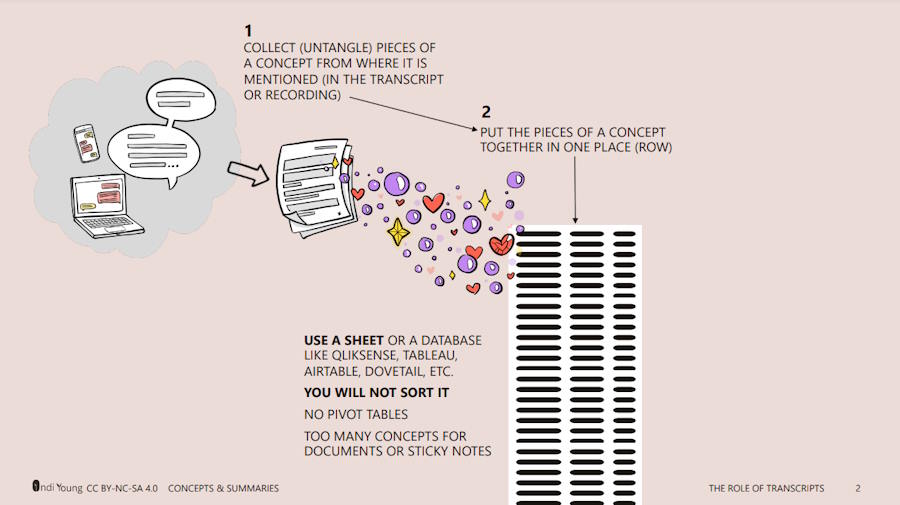
2.1 The Role of Transcripts
2.2 Quote as Concept
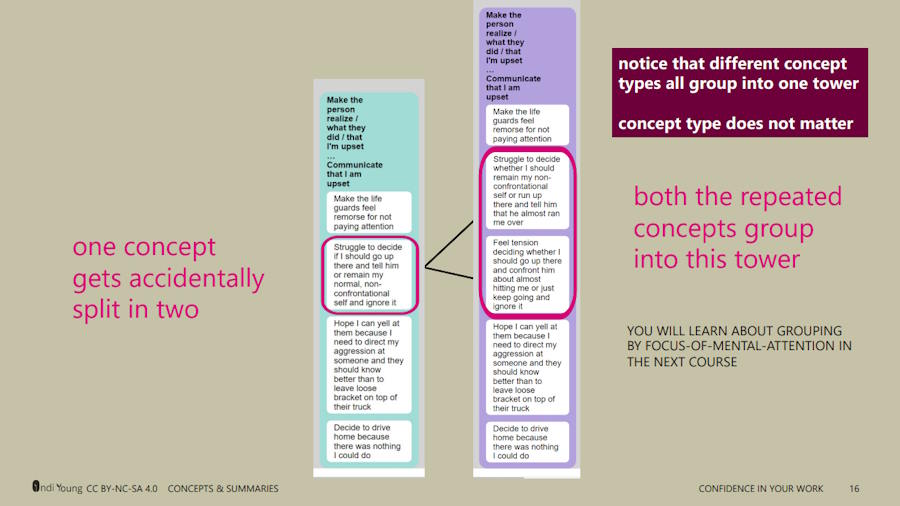
2.3 Repeated Concepts
2.4 Tangled Concepts
2.5 Implied Concepts
2.6 Prune the Quote
2.7 Example: Plastic-Wrapped Car
Section 3: Writing Summaries
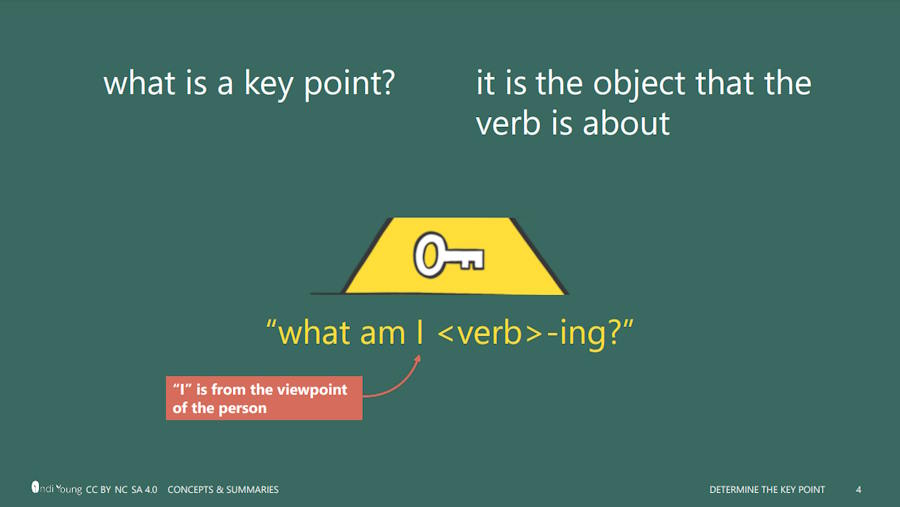
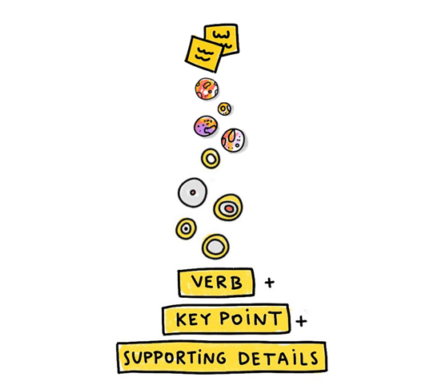
3.1 Determine the Key Point
3.2 Add Supporting Details
3.3 Use Their Words
3.4 Tame Your Verbs
3.5 Nuances of Emotions
3.6 Review for Clarity
Section 4: The Process of Synthesis
4.1 Confidence in Your Work
4.2 The Pace of Work
4.3 Working Together
4.4 Speeding It Up
4.5 Preview: Cultivating Patterns
Who is this for?
People who are tasked with making the mmSkyline.
If you are new to research, you are welcome here! This course plus Part 2 will give you a solid foundation for seeing how patterns arise from the data. It replaces the imperative to “just find affinities.” If you are an experienced researcher, these two courses are about emergent synthesis, allowing other people’s perspectives and ideas to take precedence over your own way of making sense of what was said.
The two courses give you a structure to hold ambiguity while helping patterns emerge. The courses model how to keep thinking about the stories in a rigorous way, so that a team can produce something that no one could have produced alone.
Emergent data synthesis will actually unlock some of your strategic directions.
Study this course if you are tasked with producing & maintaining the mmSkyline:
- Researcher, Quant, Qual, Mixed Methods
- Supervisor of Automated Analysis (coming soon)
- Software Engineer, Product Engineer
- Marketing
Skim the course to get a taste of what mindset and time requirements are involved, and how it is different than other affinity grouping methods:
- Product Lead, Design Lead, Content Lead
- Design Strategist
- Entrepreneur, Founder
- Ideas Person
Course Features
- 25 videos, in 4 sections
- Total video time: 11.75 hours
- Demos and examples
- Practice, reflections & quizzes
- Closed captions
- Listen w/ or w/out the screen
Testimonials
It provides phenomenal critical thinking skills that also applies to a wide range of adjacent practices (listening, being objective, empathy, interactions with colleagues, etc). It’s a wake-up call to being aware of what others are actually saying – and being there for it.
— Tracee Vetting Wolf, 24-Nov-2025
Part 1: Qualitative Data Synthesis gave me capabilities I had been craving as a self-taught UX Researcher. It showed me how to draw data from a transcript in a reproducible way and how to represent another human’s inner world with care and nuance. The course is one-of-a-kind in its equal…
— Sarah Caplan, 23-Aug-2024
Read more
Whether a seasoned practitioner, a newbie, or someone from a related discipline, learn how to let go of your biases and see patterns. You will learn to do qualitative data synthesis properly from one of the industry’s best practitioners and authors.
— anonymous, 25-Aug-2025
This is a rigorous, structured approach to get more value from qualitative research (listening sessions, interviews etc.). The course guides you step-by-step with ample opportunities to put your learning into practice and useful resources to refer back to.
— Phil Bickerdike, 22-Aug-2024
1) This was very rigorous, more so than Listening Deeply. 2) This provides a sound structure for doing data synthesis if you’re lacking a sophisticated and organized way of doing it, or are just not satisfied with how you are doing it today. 3) Like listening deeply, this course brings…
— Chris McGee, 15-Dec-2024
Read moreI loved this approach of looking at data. It validated so many parts of how I was approaching it earlier, which was truly great for me.
— Leena Jain, 11-Jul-2024
Frequently Asked Questions
Q: If I have questions about the course content, will Indi answer them for me?
A: Asking a question in the Slack community will give Indi, her team, and many other Slack members a chance to see the question and respond to it.
Q: Do the self-paced recordings (only) qualify me for Indi’s Problem Space Certification Program?
A: Not quite. You will need to Learn with Indi. In meetings with Indi you get to work on exercises together with the group. This is where we discuss nuances of context and share experiences that help others prepare to conduct their own research. Learning with Indi gives you a chance to practice your knowledge and demonstrate your understanding. It gives Indi a way to see if you understand the lessons.